

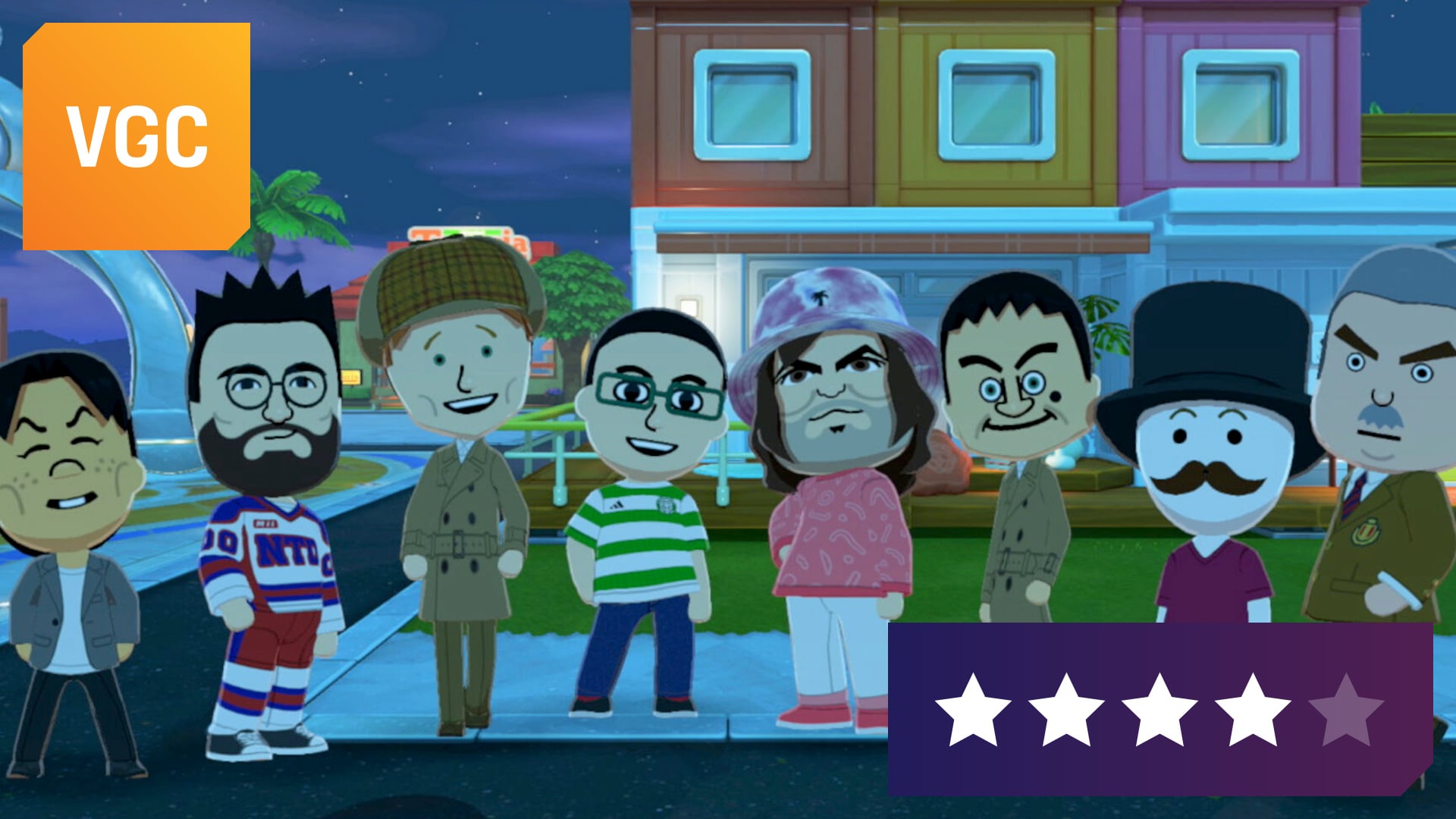
By now, chances are you’ve already seen a bunch of Tomodachi Life: Living the Dream clips and screenshots doing the rounds on social media.
Whether it’s Mii versions of famous celebrities falling in love, people showing off their more elaborate Mii creations or – more often than not – countless examples of the game seemingly having no content filter whatsoever, Nintendo’s decision to release a demo last month likely had the exact effect it was hoping for.
As a result, you might have already decided you’re buying the full version of Living the Dream. If so, feel free to scroll down, chuckle at the funny screenshots, nod knowingly at the score and continue merrily anticipating its release.
If you’re concerned, however, that the demo has already essentially shared the meat of the joke and the main release will just be more of the same, that’s where this review comes in. I’ve been playing the game for a full month now, so if you’re unsure whether you’re still going to be playing it once the joke wears off, read on.
If you’re new to it altogether, Tomodachi Life is a lightweight life sim which is far less demanding than the needs-monitoring gameplay of The Sims and Inzoi, and significantly funnier too.
This is mainly down to the fact you populate the world with your own Mii characters, the bizarre set-pieces which randomly appear, and the game’s built-in text-to-speech feature, which happily reads out any of the names, terms or occasional rude words you throw at it with a comically robotic voice that doesn’t even try to sound realistic.
The aim is simply to make your little island of Miis a happy place to live, overseeing it as a God figure while they all make friends, move in together, fall in love and have children.
Brilliantly, if you don’t want any of that, you don’t have to. Ever since the previous Tomodachi Life was released on 3DS, players have been hoping Nintendo would come good on its promise to make any potential sequel more inclusive. That’s absolutely the case here, meaning any relationships you want to make are possible.
When you create your Mii you can decide whether they’re male, female or non-binary, and can also decide whether they’re romantically interested in men, women, non-binary people, any combination of the three or none at all.
It goes further. Adults won’t fall in love with children, the fact you can choose ‘none’ means children don’t even have to fall in love with other children, and you can even assign real-life relationships to the Miis – this means if you add yourself to the game then add your sibling, parents, children or what have you, you can tell the game you’re related in real life and it’ll ensure they never have romantic feelings for each other. Phew.
It really does feel like everything has been thought of. When two Miis either become best friends or fall in love, you can change what they call each other. I added myself and my daughter to the game, and when they became friends I was able to change settings so that she now calls me ‘Daddy’ instead of ‘Chris’, and I call her ‘buddy’ like I do in real life. You can even change what each Mii calls you, the player, so naturally my own Mii calls me Big Man.
While entering your own words is undoubtedly fun, huge credit has to go to the localisation team for the rest of the game’s countless reams of hilarious dialogue. Nintendo has been nailing localised translations for a while now and Tomodachi Life: Living the Dream is no different – as I’m based in Scotland the version I played has UK English, meaning everyone speaks with English accents (booo, give us Scottish) and there’s loads of British slang in the dialogue.
Being told the first item you add to your island is free because one of your Miis “knows a bloke who knows a bloke” is a joy, as is seeing two Miis arguing at a restaurant and one declaring to the other: “You’re doing my nut in.”
“Being told the first item you add to your island is free because one of your Miis ‘knows a bloke who knows a bloke’ is a joy, as is seeing two Miis arguing at a restaurant and one declaring to the other: ‘You’re doing my nut in.’”
The series is known for its more bizarre moments and there are plenty here, usually appearing at random when characters are asleep (where you can view their dreams) or have shock lines coming from their head (where selecting them triggers a cutscene). To spoil them wouldn’t be fair but expect a healthy mix of straight-up silliness and the sort of abstract surrealism that David Lynch would be proud of.
Before long you also get a News Station, where one of your Miis reports on another silly happening, with a new one presented every day – it could be mysterious statues shaped like one of your characters showing up on the beach, or a giant Cornish pasty threatening to invade the island. It’s all very random and all very funny.
Each day you’ll likely come across something so silly you want to share it with your friends, which is why it’s bizarre that Nintendo has blocked the ability to share screenshots and videos directly from the game. While other Switch games let you upload your captures to your mobile device where they can then easily be posted to social media, that feature is banned here.
After all, it’s a shame every single person playing it doesn’t have anything in their pocket that can take photos or videos of the screen anyway… oh, wait. Naturally, this means you’ll still see social media full of Tomodachi clips of Mii characters saying outlandish things to each other, they’ll just be worse quality than if Nintendo hadn’t applied this arbitrary block.
Customisation plays a big role in the game beyond just creating your Miis, choosing what they say and rearranging the buildings and items on your island. There’s also an extensive creation suite where you can create up to 900 other in-game items – it’s split into 100 foods, 300 items of clothing, 100 ‘treasures’ (trinkets you give to Miis), 100 pieces of house interior, 100 pieces of house exterior, 100 decorative objects and 100 floor tiles.
Because you’re literally drawing these out – it’s like a more advanced version of the design feature in Animal Crossing – you can completely make over your entire island to look like anything you want if you’re good enough. Have everyone walking around in Premier League football shirts, cover the floor in slabs made of chocolate, give everyone a pet shaped like a different Sopranos character – if you can draw it, you can do it.
Sadly, mouse support isn’t available if you’re playing the game on Switch 2. Such functionality has been patched into some Switch games but this isn’t one of them. That said, the touchscreen is probably better for this sort of thing anyway, and that’s very much supported whether you’re playing on the original Switch or its successor.
“Have everyone walking around in Premier League football shirts, cover the floor in slabs made of chocolate, give everyone a pet shaped like a different Sopranos character – if you can draw it, you can do it.”
What’s there is a gem of a game filled with hilariously bizarre moments and an impressive level of customisation, then, but what happens a few weeks down the line once the initial novelty has worn off? At this point your mileage will certainly vary, and will likely depend on how comfortable you are turning the game into a daily routine.
Your main source of money is keeping all your Miis happy with food and interactions, so eventually you may find yourself having to find time to do this once a day to keep a steady stream of income flowing in. Thankfully, the game is lax when it comes to this – you could easily go for a few days without playing it and when you get back everyone’s stomachs will be empty, but you won’t be punished as a result. Just feed them and they’re happy again, no harm done.
There also naturally comes a point where the cutscenes, mini-games and dialogue start to repeat themselves, and while new moments do continue popping up it stands to reason that the more you play it, the more the game’s limitations are exposed. Watching your Miis fight over the TV by constantly changing channels is adorable the first time you see it, less so the fourth.
More creative types will get longer out of the experience – they’ll spend many hours filling the game’s maximum capacity of 70 Miis, designing every last part of their island and customising bespoke outfits for everyone living there. If that’s what appeals to you most, you’re going to be playing this one for weeks and months to come.
If your creativity doesn’t extend much beyond actually making the Miis in the first place, however, and you’re relying on the game to provide the inventive chuckles for you, it will absolutely do this – you just have to be realistic and accept that the amount of content in here is of course finite, and once the laughter dies down you’re left with a relatively straightforward life sim.
By this stage, of course, you’ll already likely have laughed your head off at so much of what Tomodachi Life: Living the Dream has had to offer. The whole thing is so absurd and off-the-wall that you can’t help but be charmed, so by the time it starts getting repetitive you’ll hopefully have already felt that you’ve had your money’s worth.
What’s more, it’s the sort of the game the entire family can enjoy. The user interface is so easy to get to grips with that my 7-year-old daughter kept taking over and playing the game for me because she loved it so much. As soon as the embargo ends she’ll be setting up her own island – unlike Animal Crossing, each user gets their own save slot – and filling it up with Miis of all her school friends. Hopefully with the romance option turned off, of course.
Like so many wonderfully silly things in life, then, the novelty here doesn’t last forever, but it’s certainly a joy while it lasts. If you’re looking for something that will add a bit of brightness to your day, and will have you sharing silly photos and videos with your friend (albeit ones taken on your phone camera), Living the Dream will fit the bill perfectly.
Reviews#Tomodachi #Life #Living #Dream #review #Nintendo #delivers #hilarious #helping #nonsense1776254888
