

There’s something distinctly 2008 financial crash about Pragmata.
Perhaps it could be down to protagonist Hugh, who simultaneously sounds like both Troy Baker and Nolan North, and wears armor reminiscent of Platinum’s Vanquish. It could be the central gameplay mechanic, which combines crunchy gun-blasting with what feels like an Xbox Live Arcade remake of Snake. Whatever it is, Pragmata feels like a remaster of an early Xbox 360 game that never existed – and that’s great.
Pragmata follows spaceman Hugh, who is separated from his team when he’s sent to a city-sized 3D printer on the moon, and Diana, a robot child who can hack the various enemies that populate the world. Your goal is to get a message back to Earth, and discover why the previously placid robots of this moon base are attempting to rip you limb from limb.
Watch our Pragmata Review Roundtable Video…
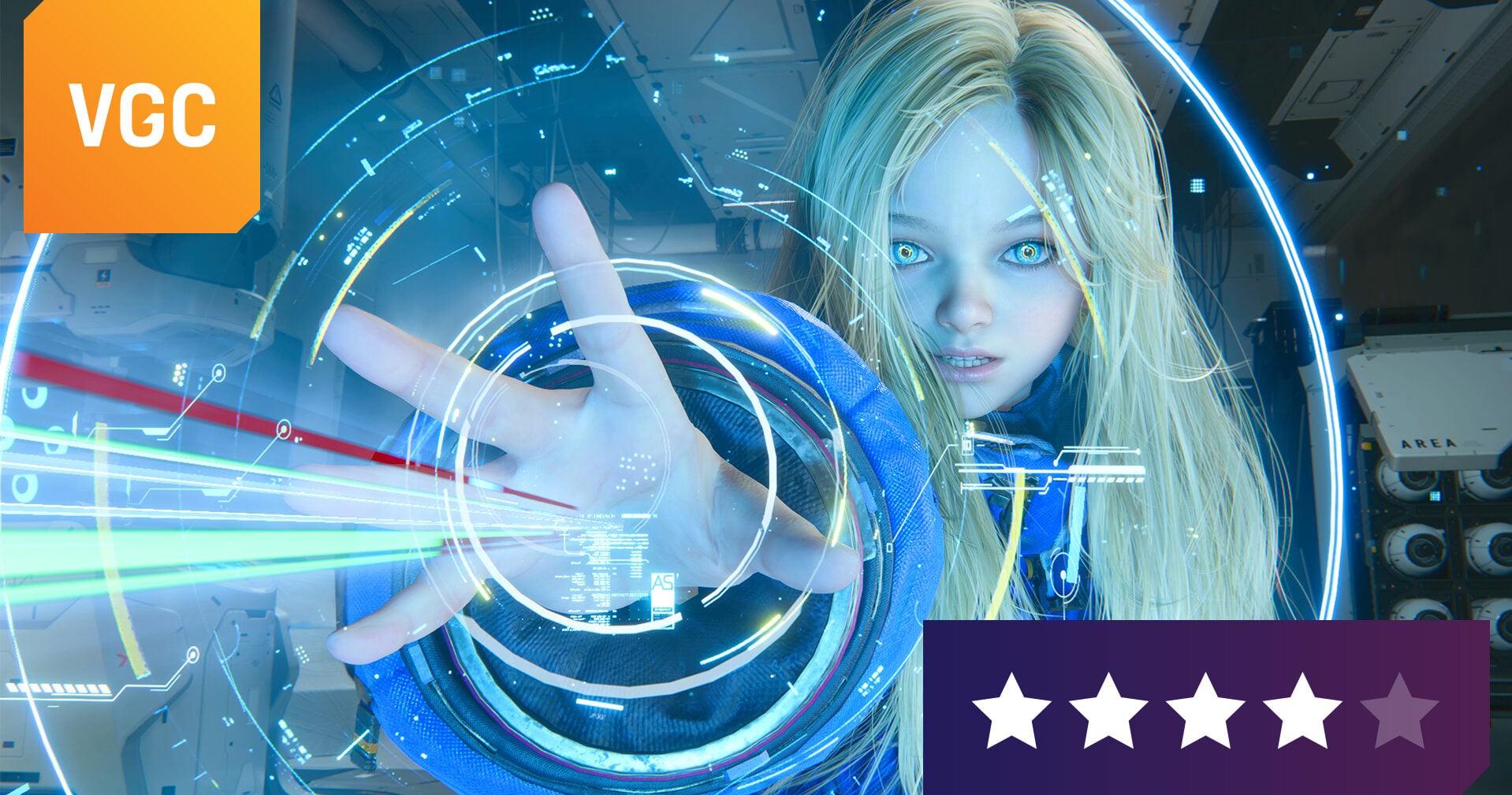
Pragmata is a third-person shooter, with the added dynamic that Diana can hack the enemies you’re shooting, making them far easier to defeat. In practise, this means that while you’re juggling traditional third-person shooting on one side of the screen, the right-hand side shows a puzzle grid that you must complete using the controller face buttons.
There’s a distinct patting your head and rubbing your stomach-style balance to all of Pragmata’s combat encounters, but it’s a compelling twist after it clicks into place. Robots amble towards you slowly, not unlike in Resident Evil, but you need to take your eyes off them to complete the hack successfully, adding tension. It’s like checking your blind spot while driving and hoping you’ve not just slammed into a parked Fiat 500.
The hacking gameplay eventually evolves with the introduction of special nodes you can activate as part of your hack, such as one that can target multiple enemies at once, or another that will cause an enemy to turn on the rest of the baddies. New enemy types are also introduced, who can block hacks entirely until you shoot off physical antennae, or who fire missiles that must be quickly hacked to divert them backward.
Action also ramps up, with combat sequences frequently filling the screen with different types of robotic enemies. Pragmata isn’t a hugely difficult game, but there were certainly sections during which I found myself overwhelmed by the number of enemies on screen, which can cause some targeting issues. Boss fights, sadly, aren’t much of a challenge on the standard modes, though in typical Capcom fashion, they’re spectacular to look at, which feels like half the fun.
As the game is set on what is largely a massive malfunctioning 3D printer, the environments of each level present a striking contrast between technology and nature. An early level in a Manhattan-like city block is jagged and incomplete, like a 3D print that’s run out of filament or malfunctioned. Some of the white corridors of the station itself can become repetitive, but the game keeps up a good pace throughout.
“Pragmata isn’t a hugely difficult game, but there were certainly sections during which I found myself overwhelmed by the number of enemies on screen.”
Another deserving nod goes to the key companion character, Diana. It seems like some kind of miracle that after one full playthrough of Pragmata, and half a dozen more hours hoovering up collectibles, the eponymous blonde child companion robot never becomes annoying. She’ll speak to Hugh as they explore the world, providing context to the player about the location, as well as an insight into the Pragmata program, which created her.
Through a charming voice acting performance and, crucially, sincere writing that focuses on Hugh and Diana’s relationship rather than Tiny Tina-like one-liners, she is genuinely pleasant to be around. The game’s overall narrative is nothing to write home about, and is strangely backloaded so that the vast majority of it is delivered when you’ve practically finished the game, but there are some memorable lore dumps dotted around terminals across the moon base.
The spine of the story is the relationship between Hugh and Diana, and while some of the emotional punches didn’t quite hit for me, if the game was suddenly doubled in length, I don’t think I’d get sick of spending time with the two of them, and that’s a big compliment to the development team.

The entire Pragmata campaign feels like a comforting hot bath for millennials, with a succession of set pieces, key-and-lock puzzles, new gear and power unlocks, before taking on one of those huge bosses with a yard-long energy bar. Pragamata doesn’t introduce a huge number of new ideas, but it feels like the most polished version of the PlatinumGames / Shinji Mikami action template we’ve seen to date, and that’s a big compliment for fans of the genre.
Pragmata will only take a few evenings to complete, and I’d have liked to have seen more of the very light Metroidvania elements in terms of areas that are locked off by later abilities, but there’s a decent amount of collectibles, upgrades, and other challenges that can be found by backtracking.
The hacking interface and Hugh’s combat abilities are well-realized and look fantastic, creating fireworks on screen when everything works in harmony. While there aren’t a huge number of enemy designs, they are easily readable, which is key when attempting to do multiple things at once.
There’s something charmingly simple about Pragmata. It’s an 8-hour, linear third-person shooter with a charming, if fairly generic, story. We used to get dozens of these games a year; now, with this production value, they’re such a rarity that it’s a breath of fresh air. Pragmata has a central focus, and Capcom has drilled down into it with expert precision.
Reviews#Pragmata #Review #Capcoms #charming #scifi #shooter #feels #moons1776092999
