


Night City is intoxicating. The neon lights; the rainsoaked streets; the neverending vice; the graffitied dark alleyways. Anything is possible: you can rule with an iron fist, or be crushed like an ant beneath the boot of corporate authority. It’s a place where you make the rules, and you choose if you want to follow them. That feeling of phantom liberty is what makes Cyberpunk 2077 so perfect: its world is familiar (you get up, you grind, you sleep, repeat), yet equally so foreign. Its lawlessness is enticing, its cyberware a dystopian vision of a potential future that, in many ways, doesn’t feel too far away. It’s that essence that acts as a throughline for CD Projekt Red’s RPG, and the tabletop game that it’s inspired by. It’s that throughline that WeirdCo’s Cyberpunk TCG had to get right, and on the whole, I’d argue it nails it.
Let’s start with the aesthetics. The alpha box that I received in the mail was surprisingly compact compared to the chonky cardboard packaging that we’re used to with Magic: The Gathering and Riftbound, but when I pulled back the outer packing, I found myself letting out a little gasp of excitement. Blazing neon yellow, the entire package is about the size of a small box of chocolates, sporting Cyberpunk 2077’s signature roughed-up industrial look, emblazoned with ‘Welcome to Night City.’ From here, you’re met with two boxes of standard dice (the same ones that you play D&D with) and your cards. For this set, we were given an Arasaka-focused deck, which felt a little more aggro, and a V-centric ‘rebel’ deck, featuring the likes of fan-favorites Jackie Welles and Viktor Vector.
For an alpha Kickstarter, the game’s presentation is stunning. The attention to detail is sublime, and everything that you need to pitch up and play is there in a handy little box. From instruction cards to paper playmats with extra details, it’s a complete, one-shot product that, in its excellence, puts other TCGs to shame.

The instructions, however, do take a moment to get your head around. The terminology borrows a lot of Cyberpunk’s technojargon, with ‘Gigs’ being the primary focal point of the game, while ‘Eddies’ effectively act as your mana (lands in Magic: The Gathering, or runes in Riftbound). Then there’s the RAM system, which puts a limiter on the power level of your deck. It’s a lot to take in all at once, and while I appreciate the game’s commitment to its roots, the terminology doesn’t make things any clearer.
Your primary aim is to steal Gigs from other players. On the surface this is a little confusing, but quickly becomes second nature. Every turn, you roll a Gig die, one of the aforementioned D&D dice, which are placed down the side of your mat. The number you roll determines the amount of Street Cred you have, so if I roll a D4 and get a three, then a D6 and get a six, I have nine Street Cred. Your Street Cred may trigger new effects on cards (having less than 20 Streed Cred on Yorinobu Arasaka sees me discard a card, for example), and can be raised and lowered by playing cards with relevant effects. It’s a pretty cool system, but I often found it to be largely irrelevant as, by rolling a dice every turn, you often exceed the maximum Street Cred needed to trigger top-tier effects relatively early on, negating any real cost.
From here, you can choose to attack exhausted (or ‘spent’) enemy units, or the player themselves. Specific cards are labeled as ‘Blockers,’ and only these can stop attacks getting through to the player – you cannot block with non-Blocker units. I quickly found this to be problematic, as having a whole line of Blockers slowed down the action and made things feel a little one-sided, while having no Blockers at all meant that you were constantly trading Gigs. There are a good amount of Blockers, and certain cards can turn normal ones into Blockers, but other than throwing your attacking cards at them, there’s no easy way to get rid of them. There are no Instant spells, so everything has to be played on your turn, which limits counterplay more generally, but often makes Blockers feel like an impenetrable wall in the early game.
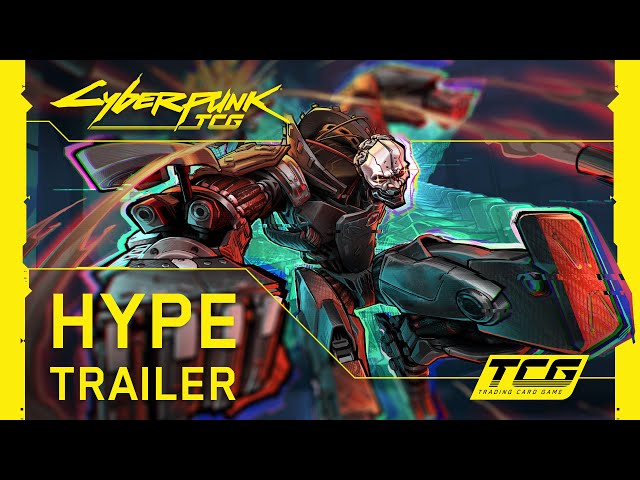
I also found that the game really takes a while to ramp up. There are no mana cards in the Cyberpunk TCG; instead, you sell your own cards for Eddies, with sellable cards denoted with an Eddies symbol in the top left corner. You have three Legend cards in your deck, which all enter the field face-down in a randomized order. You can use these for Eddies once they’re flipped, too, but they also cost two Eddies to activate. I found myself losing out on low-cost cards in order to beef up my mana pool, then using said pitiful starter pool to flip my Legends for more mana, in turn leaving me stuck with a full hand of higher-cost cards at early stages in the game, stifling the action.
As I said, Legends also come into play face-down, and as you spend Eddies you flip them at random. While this sounds fun on paper, the V deck’s Legends really paled when compared to the Arasaka one, with Viktor Vector’s one-time effect making him relatively useless for the rest of the game compared to Saburo Arasaka’s +1 modifier and Yorinobu’s consistent card-drawing. Arasaka’s Legends feel more cohesive, and work in tandem to create a strong, unit-focused aggro deck.

While the game itself is generally pretty fun, some of its rules can be a little confusing. The win-condition of getting six Gigs to triumph is relatively simple (seven in overtime), but some card mechanics proved a little perplexing. The infamous Sandevistan, for example, allows you to attack spent units when its cost is paid. Given that you have to pay its cost to equip it to another card, it then automatically gives you the ability to attack spent units, but, per the game’s ruleset, you can attack spent units during your attack phase anyway. It’s maybe my brain not quite computing things (there’s a lot to get your head around), but some of the card effect descriptions felt somewhat light on detail, and several cards had no effects at all. These latter ones felt a little bit pointless, and more like padding than anything else.
I do, however, like the game’s addition of the RAM system, which limits the cards you can put in your deck depending upon the total RAM of your respective colored Legends. In the Arasaka deck, for example, Saburo Arasaka and Goro Takemura provide two green RAM each, making the total RAM level four, so any future additions to the deck must be four RAM or lower. This should help mitigate some of the ugly power creep that we’ve seen in the likes of MTG, where often it feels like those who can splash the cash on expensive cards or sit for hours on end studying deck combos are inevitably going to win.

It’s obviously worth noting, however, that this is an alpha kit, and I expect things will change drastically before release. I think that the Street Cred system is the game’s coolest, most unique mechanic, but in its current state it’s easily forgotten and doesn’t feel like it adds much. It’s a simple fix, though: change some of the numbers, and it’ll become relevant again.
There are certainly some teething issues here, and while I’m always happy to pick up a Riftbound deck and get playing, I’m not sure that, in its current iteration, the Cyberpunk TCG would be high on my ‘I want to play this game tonight’ list. Its premise, however, is unlike anything on the market, so with some refining I really do think it could be something truly special. Not unlike its inspiration, it’s a little rough around the edges right now, but with a bit of love it could truly be something great.
The Cyberpunk TCG launches on Tuesday, March 17 at 9am PST / 12pm EST / 5pm BST / 6pm CEST. You can check out the TCG’s Kickstarter here, and pick up a snazzy Foil Nova Rare Lucy if you choose to back it. Man, she really is stunning.
Cyberpunk 2077,CD Projekt RED,CD ProjektCyberpunk 2077,CD Projekt RED,CD Projekt,RPG#familiar #twist #fate #Cyberpunk #2077039s #TCG #adaptation #lot #time #oven1770407885
