

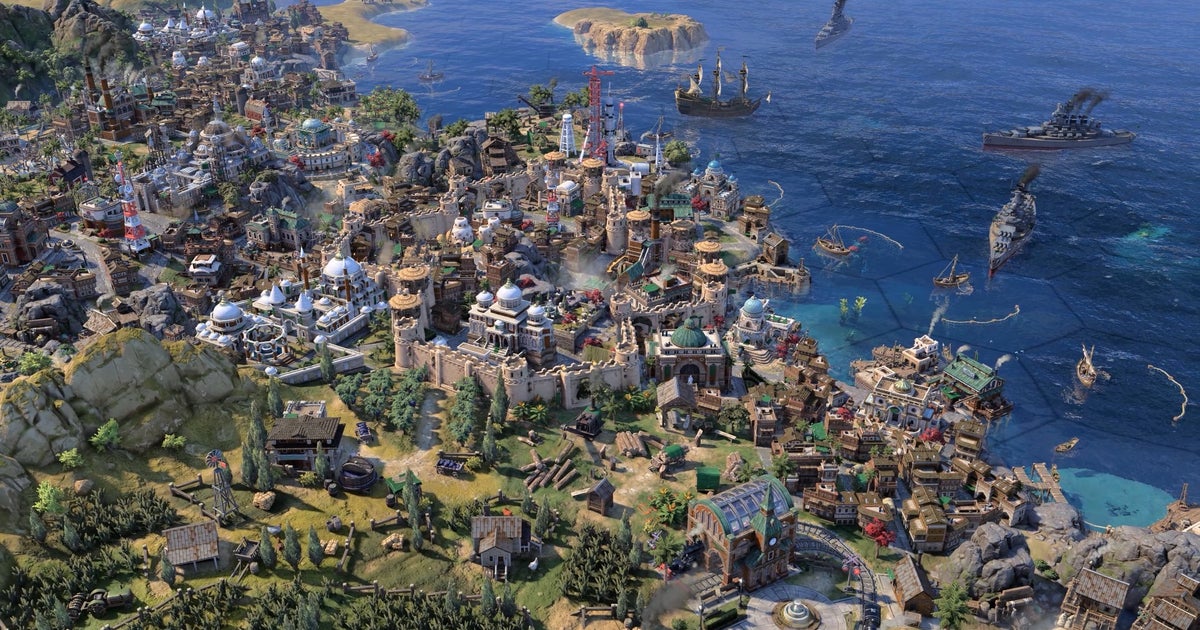
As any Civ player knows, time has a habit of passing. Next week, Civ 7 will turn a year old. It’s been a year of regular additions and tweaks following the mixed initial reception to Firaxis’ attempt to do something different with their grant strategy behemoth. Fitting, then, that the devs have rung in that first birthday by revealing when they’re hoping to drop some big changes that’ll have “major implications” for Civ 7.
Watch on YouTube
As outlined in a video and blog post fronted by Civ creative director Ed Beach, these larger changes and additions will be arriving as part of a free update dubbed Test of Time, which Firaxis are “tentatively aiming” to drop this spring. Headlining its contents thus far is the return of the ability to play as one civilization throug the whole game if you wish, something the studio announced they were working on last year.
Beach outlined how exactly it’ll be implemented here, making clear it’s not a separate game mode or a replacement for the base game’s system of shifting civs with each age change. Instead, when you hit the end of an age, you’ll simply be offered the option to keep on plugging with the same civ, with AI civs mirroring whether you choose to stick or twist in their own end of age decisions. To help ensure long-running civs don’t get stale, Firaxis have opted to introduce a couple of new features – Apex Ages and Syncretism.
The first of those is a “sole Age where this civ gets its full, unique kit”, designed to mirror the period when it was in its prime or fits best with the world. Beach provided Rome in the antiquity age as an example. “Civs played outside of their Apex Age retain a core, defining part of their kit and gain a new Age-appropriate Civic Tree,” he added. “In our example, this tree includes a unique node, Roman Renaissance, that lets you optionally unlock more Age-appropriate Roman perks, as well as two nodes based on your civ’s attributes – in Rome’s case that’s Cultural and Militaristic. These attribute-based nodes are common for all civs outside of their Apex Age, providing perks that are relevant for the current Age’s mechanics.”
Syncretism, meanwhile, gives you the option “to study a Mastery on your new unique Civic node, and adopt the Unique Units or Infrastructure from another civilization currently in its Apex Age”. So, if you’re playing an ancient civ and want to incorporate another civ’s unique exploration age ships into your fleet to bolster your effectiveness at that point in time, you can do so.
Alongside the ability to play as one civ throughout, Firaxis are using the update to switch up how victories are earned with the hopes of offering more variety in winning strategies via Military, Economy, Culture, or Science, rather than pushing you into a single legacy path. Finally, legacy paths themselves have been replaced with new “Triumphs”, which offer a wide range of optional, challenging objectives to complete as you go, allowing you to score points in the various winning metrics civs are measured by.
So, that’s Tests of Time. Prior to the big update, Firaxis also have a smaller update dubbed 1.3.2 set to arrive soon. That one’ll bring nested tooltips, more civ balancing tweaks, the ability to immediately see how useful a tile is, plus reworks of AI diplomacy and coastal raids. A free leader – Gilgamesh – will also be arriving for every player with 1.3.2 as a nice little anniversary present.
Multiplayer Competitive,Firaxis Games,Strategy,Bird view / Isometric,Simulation,2K,Sid Meier’s Civilization VII,Strategy: Turn-Based Strategy,Single Player#Civilization #7039s #big #Test #Time #update #that039ll #bring #playing #civ #game #set #drop #spring1770131387
