

Scotland is an inspired choice for the setting of a Silent Hill game. It’s not only one of the most beautiful countries in the world, but it’s also got the capacity to be one of the most mysterious.
Silent Hill: Townfall is the next game from Screen Burn (previously NoCode). The irony isn’t lost on me that I had to travel over 5,000 miles to see a game that’s being made ten minutes from my house, but I’m glad I did. My hands-off demo session was led by John McKellan, the game’s director and the founder of Screen Burn.
The game takes place in 1996 and is set in the fictional town of St. Amelia, set on the very real North coast of Scotland. The game follows Simon Ordell, a man who finds himself perennially stuck in the town. How he got here, and why he keeps waking up on the damp docks of St. Amelia, is the central mystery of the game.
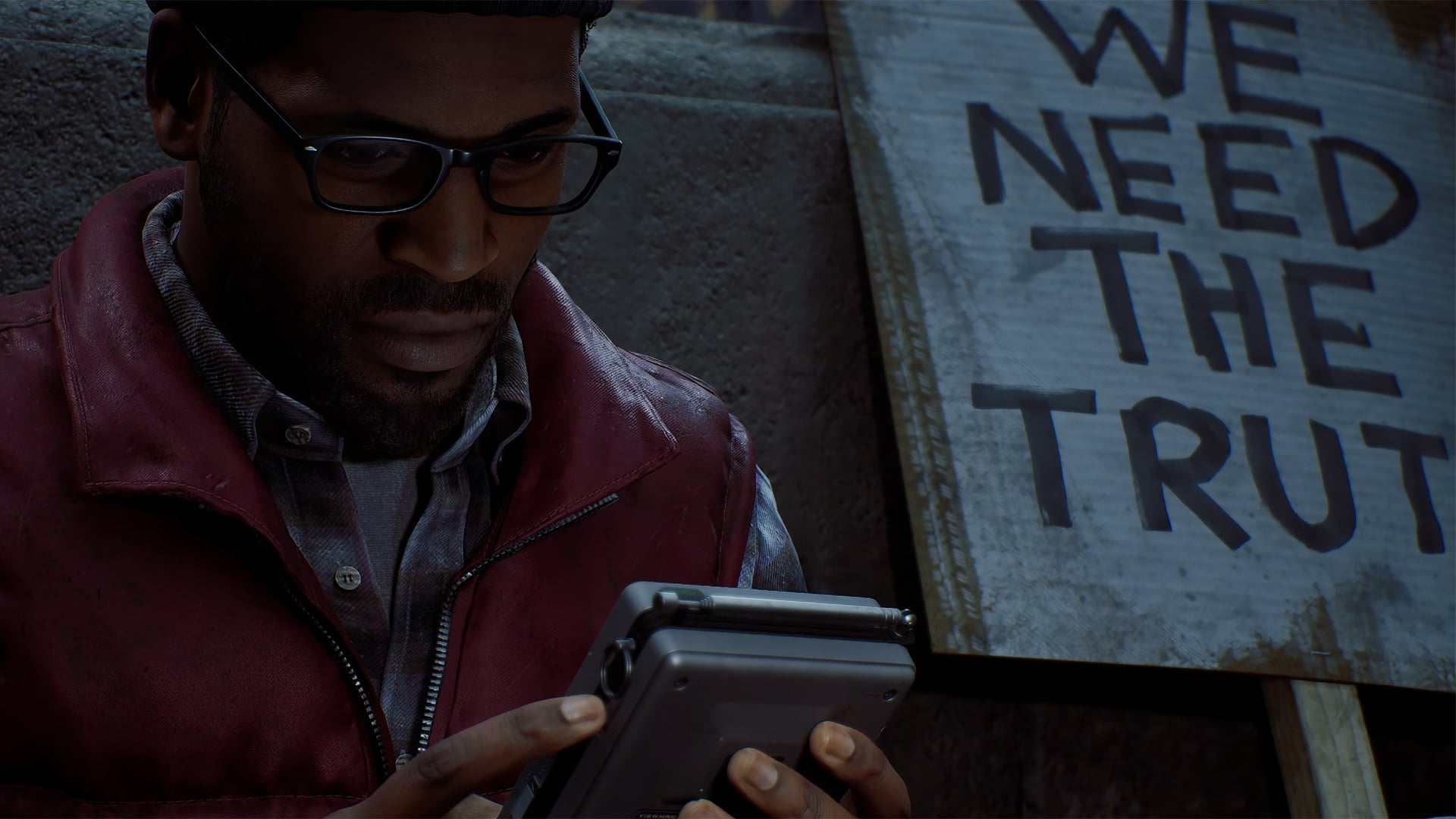
Silent Hill: Townfall’s central mechanic is the CRTV, a portable television that the player can tune. By doing this, the player can receive messages, uncover scattered pieces of video, or even see enemies.

As our demo opens, Simon receives a broken-up message from someone asking for help. The footage is fuzzy, and distorted. John McKellan tells us that Screen Burn spent a lot of time running game footage into authentic analogue video equiptment, before sending it back into the game, to achieve the effect.
In the video clip, there’s a mysterious door that Simon must seek out. All we know is that it’s clearly the back door to one of the houses in the town, but it’s up to us to locate it. It’s here that we get our first chance to explore the St. Amelia. McKellan describes it as a town that would look like something out of a postcard on a summer’s day, but in the fog, mist, and rain, it’s a deeply unsettling location.
It’s a strange juxtaposition having somewhere that feels so familiar to me also feel so unsafe. It felt like walking home from a night out through a part of town that’s perfectly safe during the day, but carries a bit of an edge after dark.

The game is undoubtedly visually impressive. The architecture is frighteningly accurate, and the slight dinge of white walls that have been blasted by coastal rain for years makes this perhaps Scotland’s most authentic depiction in a video game. Poor Scotland.
Once we found the house he was after, the game’s puzzles began. The puzzles are reminiscent of Stories Untold or Observation, the two previous Screen Burn games. There’s a fascination with old tech, and tinkering with equipment as one part of a larger puzzle. In this instance, we had to restore power to the house we were exploring in order to turn on a laptop.
We head under the stairs to the power box, and here’s where we found the most authentically Scottish part of Silent Hill: Townfall so far: the leckie card. For those too young or not Scottish enough to know, electricity meters in Scotland used to run on pre-paid cards, which would be inserted into a box in a home. When the card ran out, it had to be topped up at the local newsagent’s.
This detail baffled the Americans in my demo. A note attached to the in-game card informs us that the local newsagent is our next destination.
Credit to the McKellan for describing a newsagent as “like a grocery store,” when any Scottish person knows fine well that’s only the case if your groceries are cans of juice and Rizla.

It’s on our way to the newsagents that we encounter our first enemy. This was classic Silent Hill fare. A deformed figure, that seemed to have an axe growing out of its head, shuffled around the tightly packed streets surrounding the newsagent.
With our CRTV, we could get an outline of where it moved around, and since we had no weapons whatsoever, stealth was our only option. According to Screen Burn, these enemies aren’t locked to specific paths; instead, they’ll explore the area around them, making them unpredictable when it comes to sneaking past them and incredibly dangerous.
Once inside the strikingly authentic-looking small town newsagent, we grab our fresh powercard and make our way out to the high street. The demo concluded with a short demonstration of the game’s melee combat. It doesn’t seem like the enemies will take too many hits to put down, however, they also hit hard, making each shot count.
For many players, this one-on-one combat will be a last resort for when stealth goes sideways, but it was interesting to see it in action.

After I left the hands-off demo of Silent Hill: Townfall, it was hard to think about much else. The elephant in the room is that as a Scottish person, it’s novel to see my country represented, but not only that, represented so authentically.
The CRTV mechanics are pure Screen Burn. The use of old tech as a gameplay mechanic, paired with the paranormal goings on of the world of Silent Hill, is such a natural match. For a series that seemed like it was destined to fade into obscurity outside of a dedicated fanbase, Silent Hill 2, Silent Hill F and now Silent Hill: Townfall have injected a huge amount of life into the series.
If I’d been handed the controller, I’d have happily played Silent Hill:Townfall for the rest of the day.
Features#Silent #Hill #Townfall #authentically #scary #authentically #Scottish1781358591
